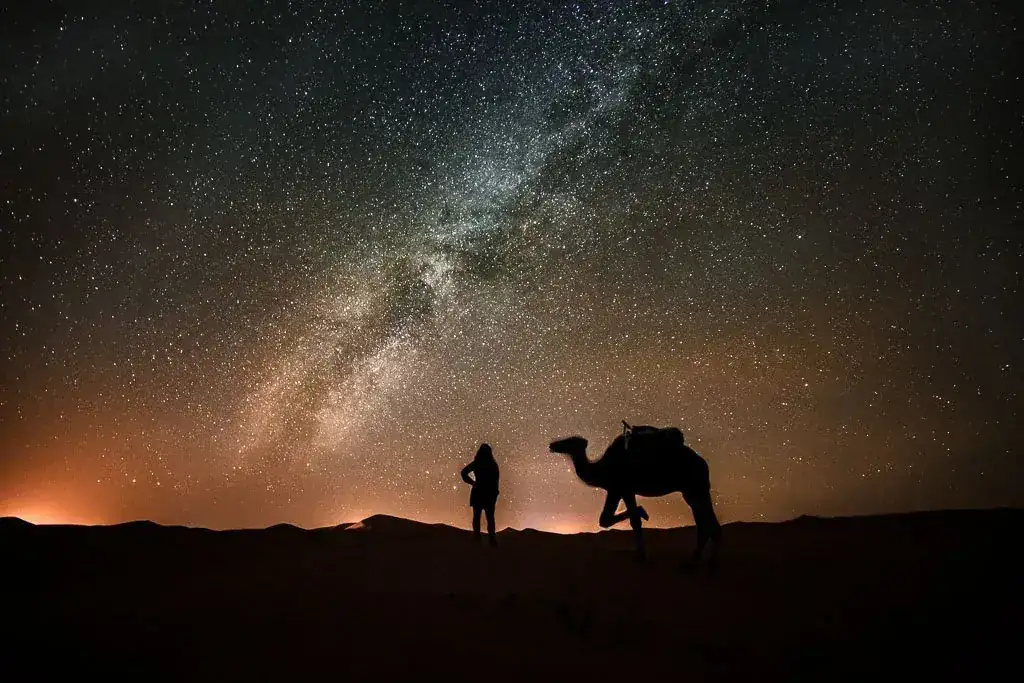
The first time most guests step away from the camp lanterns and look up, they stop talking. There is no city within a hundred kilometres, the air is exceptionally dry, and the sky here does something that photographs never quite convey.
Choose your moon, not just your month
This is the single most useful piece of advice we can give. A full moon over the dunes is beautiful, and it will also wash out the Milky Way completely. If the galaxy is your goal, aim for the week either side of a new moon.
The Milky Way core is visible from roughly April to September, highest and brightest in June and July. Outside those months you still get a spectacular sky — Orion dominates the winter, and winter air is the clearest of the year.
What you can see without any equipment
- The Milky Way band, clearly, on any moonless summer night
- Satellites crossing overhead, especially in the hour after dusk
- Shooting stars — most guests see several without trying
- Jupiter, Saturn and Venus bright enough to cast reflections
Camera settings that work here
A useful starting point: a wide lens at f/2.8 or faster, ISO 3200, 15 to 20 seconds, manual focus set on a bright star using live view at maximum magnification. Adjust from there.
Bring a tripod. Bring spare batteries — winter nights eat them. Put a dune ridge or a lit tent in the foreground; an empty sky is technically impressive and emotionally flat.
How we do it at camp
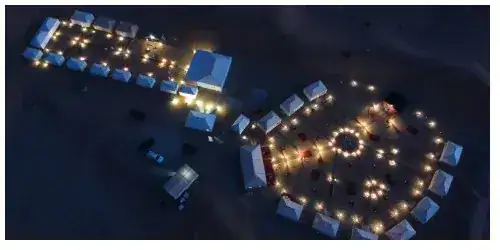
After dinner we dim the lanterns and bring blankets and cushions out onto the sand. Our team grew up navigating by these stars and will happily point out what nomads use to find their way, which is a better introduction to the sky than any app.
Give your eyes twenty minutes to adjust, and keep your phone screen off. That alone changes what you can see.
Stay with us in Merzouga
Private ensuite tents with air conditioning and heating, dinner and breakfast, the sunset camel ride and sandboarding — all included.
Request availability